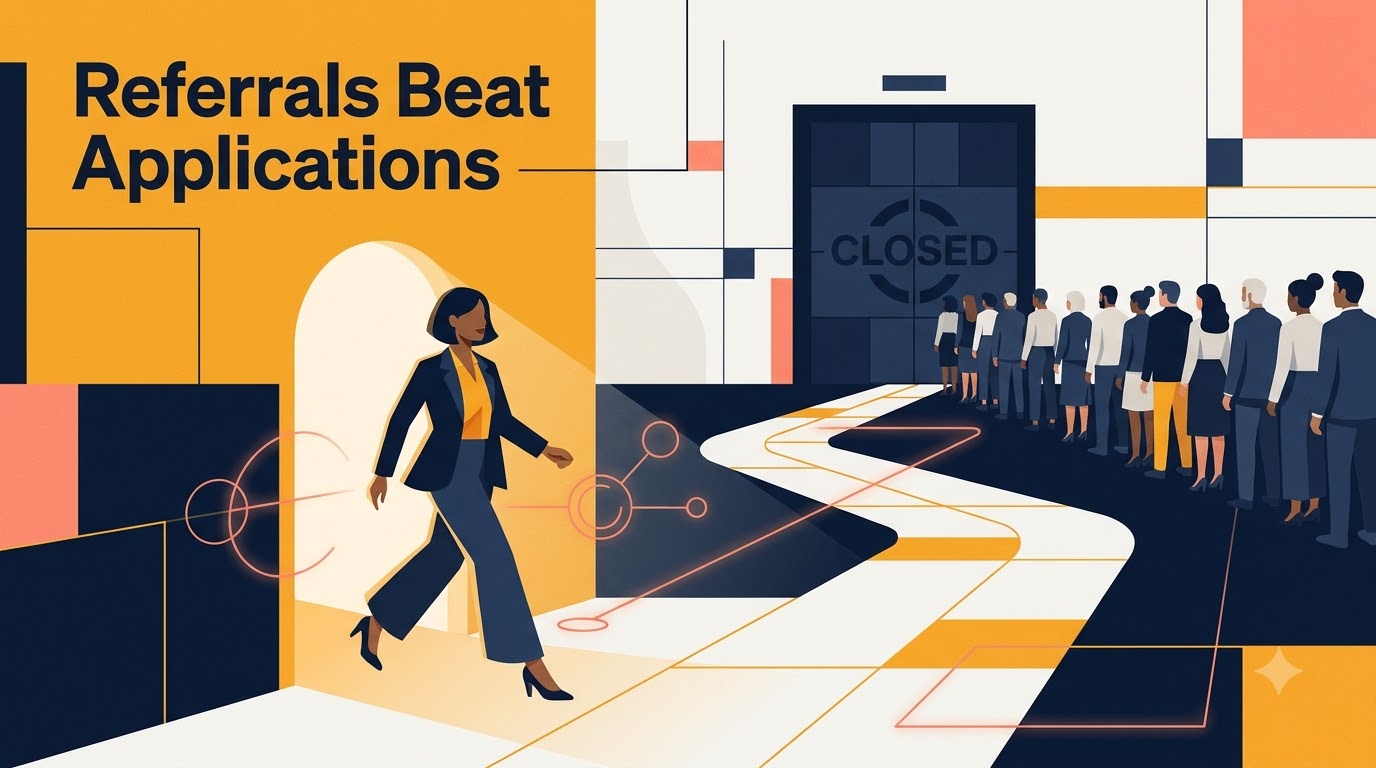
Learning how to get an employee referral with no connections is as simple as running a targeted, three-step cold outreach system. By targeting the right internal employees and lowering the friction of your request, you can bypass the resume black hole and land directly on a recruiter's desk.
Referred candidates convert to hires at a rate of over 20%, compared to a dismal 2% for cold online applications. Companies actively incentivize their staff with referral bonuses of ₹25,000 to ₹1,00,000+, meaning employees want to refer qualified candidates like you.
By the end of this guide, you will be able to identify high-signal employees, write high-converting outreach messages, and execute a multi-day follow-up sequence that gets replies.
Why Employee Referrals Are Your Fastest Path to an Interview
Employee referrals accelerate your hiring pipeline because they establish immediate trust and fast-track your resume directly to human decision-makers.
Cold applications get filtered by keyword-matching software before a human ever sees them. A referred candidate walks in with pre-screening already done by someone the company trusts. Recruiters at top companies like Flipkart, Razorpay, and Swiggy openly state that referred candidates move through pipelines faster because the vetting risk is lower.
This is why referral bonuses exist at nearly every mid-to-large tech company in India, often ranging from ₹25,000 to ₹1,00,000+ depending on the role. Companies run these programs because referred hires cost less to source, get hired faster, and stick around longer.
LinkedIn's hiring data shows referred candidates convert to hires at significantly higher rates. Some internal company data puts referral hire-rates well above 20%, compared to roughly 2% for a cold online application.
The structural reason is trust transfer. When an engineer at Zoho refers you, they are putting their own professional credibility on the line. Hiring managers know this, so they treat referred resumes differently by reading them instead of scanning them.
Additionally, referred candidates often skip the initial screening round entirely. The recruiter already has informal signal on culture fit and technical competence from the referrer's conversation.
While referrals do not guarantee a job offer, they guarantee attention. In a market where thousands of applications hit each open tech role, attention is the bottleneck—and a referral is the fastest way to buy it.
How to Get an Employee Referral With No Connections: Identifying the Right Contacts
Identifying the right contact requires filtering LinkedIn's company directory by shared educational background, team proximity, and platform activity.
Open the company's LinkedIn page and click the "Alumni" tab to find common ground. IIT, BITS Pilani, NIT, and even tier-2 engineering colleges usually show up as filters once you search employees at companies like Razorpay, Freshworks, or Amazon India. A shared college is the single easiest connector to mention in your first line.
If college does not yield results, search by shared LinkedIn groups. Direct overlaps in groups like "Bangalore Product Managers" or "Indian SDEs Abroad" give you a legitimate reason to reach out instead of cold-messaging a stranger.
Next, narrow by role and team rather than just company size. Searching "Freshworks" gets you thousands of results, but adding "Product Manager" and "Growth" narrows it down to a manageable target pool. Use LinkedIn's filters for Current Company, Title, and Location to ensure accuracy.
Once you have a shortlist of 5 to 10 people, evaluate their profiles against three key criteria:
-
Tenure length. Avoid people who joined under 3 months ago as they lack internal credibility. Target employees with 1 to 3 years of tenure who understand the internal processes and the referral bonus structures, which often pay ₹15,000 to ₹50,000.
-
Team proximity. Ensure their daily role matches your target function. A backend engineer on the payments team cannot meaningfully refer you into a frontend design role.
-
Recent activity. Focus on users who have posted or commented on LinkedIn within the last 30 days. Active users are significantly more likely to see and respond to your message.
Prioritize the contact who checks all three boxes rather than targeting the most senior title on the org chart.
The 3-Part Cold Outreach Message Template That Gets Replies
The cold outreach messages that get replies always combine a hyper-personalized opener, a brief two-sentence value link, and an extremely low-friction ask.
Skip any of these three elements, and you risk being ignored like the dozens of generic "Hi, are there any openings?" messages employees receive daily.
-
The personalized opener. Reference something specific about their work, such as a technical article they wrote or a project their team shipped. For example: "Saw your team's post about migrating Flipkart's checkout to microservices—I worked on something similar and it broke in unexpected ways."
-
The value link. Connect your actual experience directly to their team's current focus. Keep it to one or two sentences, such as: "I've spent the last 3 years building payment reconciliation systems in Node.js, and I noticed your team's job description mentions similar work."
-
The low-friction ask. Keep your initial request tiny and focused on their perspective rather than a direct referral. Ask for advice or a brief chat: "Would you be open to a 10-minute call about what it's like working on that team? Not asking for a referral, just trying to understand the role better."
Here is the fill-in template you can use today:
"Hi [Name], I saw [specific detail about their work/post/team]. I've been working on [specific relevant experience] for [X years], and I think there's real overlap with what your team does at [Company]. Would you have 10 minutes for a quick call about the role — not asking for anything more than your perspective right now."
The ask stays low-friction on purpose. The referral request comes later, after you have built rapport during your conversation.
Your Follow-Up Sequence: Timing, Adjustments, and When to Walk Away
A successful follow-up sequence requires exactly three outreach attempts spaced across 16 days before you gracefully disengage.
Most candidates either follow up too quickly or give up after a single unanswered message. Professionals at companies like Flipkart or Razorpay receive dozens of messages a week, meaning your initial note likely got buried rather than intentionally ignored.
-
Day 4: The nudge. Keep this under two lines without inducing guilt. Simply say: "Hey [Name], know things get busy — wanted to bump this up in case it slipped by. Still happy to send my resume over if useful."
-
Day 9: The value add. Provide a fresh reason to re-engage, such as a recent company announcement. Try: "Saw [Company] just announced the Bangalore expansion — figured the timing might line up with what we discussed. No pressure either way, just wanted to flag it."
-
Day 16: The graceful exit. Make it easy for them to opt out, which often triggers a polite response. Say: "Totally understand if this isn't the right time — I'll stop following up here. If anything opens up down the line, I'd still love to connect. Thanks for reading these!"
You must walk away for good if you receive zero response after three messages, if they provide a soft rejection, or if they view your profile repeatedly without replying. Treat silence as valuable data and move on to the next contact on your list.
When This Cold-Outreach System Does NOT Apply (And What to Do Instead)
This cold outreach system fails when applied to early-stage startups under 50 people, executive-level roles, highly secretive teams, or if you have a messy online presence.
-
Startups under 50 people. Small teams lack structured referral systems and dedicated HR managers, meaning founders hire almost exclusively through trusted warm networks. Instead of cold messaging, seek warm introductions through mutual connections, advisors, or existing investors.
-
C-level and VP roles. Executive hiring is managed through board networks and search firms rather than peer referrals. If targeting a leadership position, focus your efforts on building long-term industry visibility through writing, speaking, and advisory work.
-
Secretive or high-security teams. Security, fraud, and unreleased product divisions have strict confidentiality protocols that prevent employees from discussing their work. Expect brief, cautious replies, and do not press for internal details if you do get a response.
-
A negative public footprint. An employee will thoroughly audit your LinkedIn profile and public repositories before agreeing to vouch for you. Before reaching out, clean up public disputes, fix abandoned repositories, and ensure your profile presents a polished, professional image.
In these specific scenarios, changing your outreach template will not help. You must adapt your strategy to the specific context of the role and organization.
Real Message Examples: A Side-by-Side Comparison of What Works and What Gets Ignored
Comparing successful outreach messages to failed ones highlights the critical difference between demanding a favor and starting a mutually beneficial conversation.
| Outreach Phase | What Gets Ignored (The Bad Way) | What Actually Works (The Good Way) | Why It Works |
|---|---|---|---|
| The Opener | "Hi, I saw you work at Razorpay. I'm looking for job opportunities and was wondering if you could refer me." | "Hi Ankit, saw you moved from backend to the payments infra team at Razorpay last year. I've been building similar reconciliation systems at my current gig and been curious how you handled the scaling piece." | Demonstrates genuine research on the individual rather than sending a transactional mass blast. |
| The Value Prop | "I have 4 years of experience in Java and Spring Boot and I think I'd be a good fit for any open roles." | "I've spent the last two years at Freshworks building rate-limiting for a multi-tenant API, which sounds close to what your team's dealing with on the gateway side." | Connects highly specific technical skills directly to the actual engineering challenges of their team. |
| The Ask | "Could you refer me for any open positions at your company? I'd really appreciate it." | "I saw the SDE-2 opening on your careers page (posted Jan 8). Would you be open to a 10-minute call this week, and if it feels like a fit, maybe pointing me toward the right person for a referral?" | Targets a specific listing, requests a brief low-friction conversation, and avoids assuming the referral. |
FAQ
How long should I wait before asking for a referral during our conversation? Do not ask for a referral in your very first message or the opening minutes of your call. Instead, focus the first 10 minutes on understanding their day-to-day challenges and showing your technical competence. If the conversation goes well, close by asking if they would feel comfortable submitting your resume through their internal portal.
Do employees actually benefit from referring a stranger? Yes, employees at mid-to-large Indian tech companies have a strong financial incentive to refer qualified candidates. Referral bonuses typically range from ₹15,000 to over ₹1,00,000 depending on seniority. Vouching for solid talent also boosts their internal reputation with hiring managers.
What should I do if the contact views my profile but does not reply? If someone views your profile without replying, it often means they are interested but busy, or they are evaluating your public background. Treat this as a warm signal and send your Day 4 follow-up nudge exactly as scheduled. Ensure your profile, pinned projects, and bio are fully polished to convert their curiosity into a response.
Should I reach out to multiple people at the same company simultaneously? No, do not message multiple people on the same team or company at the same time. If they discuss recruitment internally, cross-contacting makes you look desperate and spammy. Reach out to your top-priority contact first, wait for the full 16-day sequence to play out, and only move to a second contact if you receive complete silence.
Turn Cold Outreach Into Warm Opportunities
Moving from cold application to warm referral requires shifting your mindset from asking for favors to building low-friction professional connections.
The ultimate takeaway is that employees are highly incentivized to refer you, but only if you prove you are a low-risk, high-value candidate through specific research and low-friction requests.
Your immediate next action is to select three target companies, find 5 active employees who share an alma mater or group with you on LinkedIn, and draft your personalized openers today.