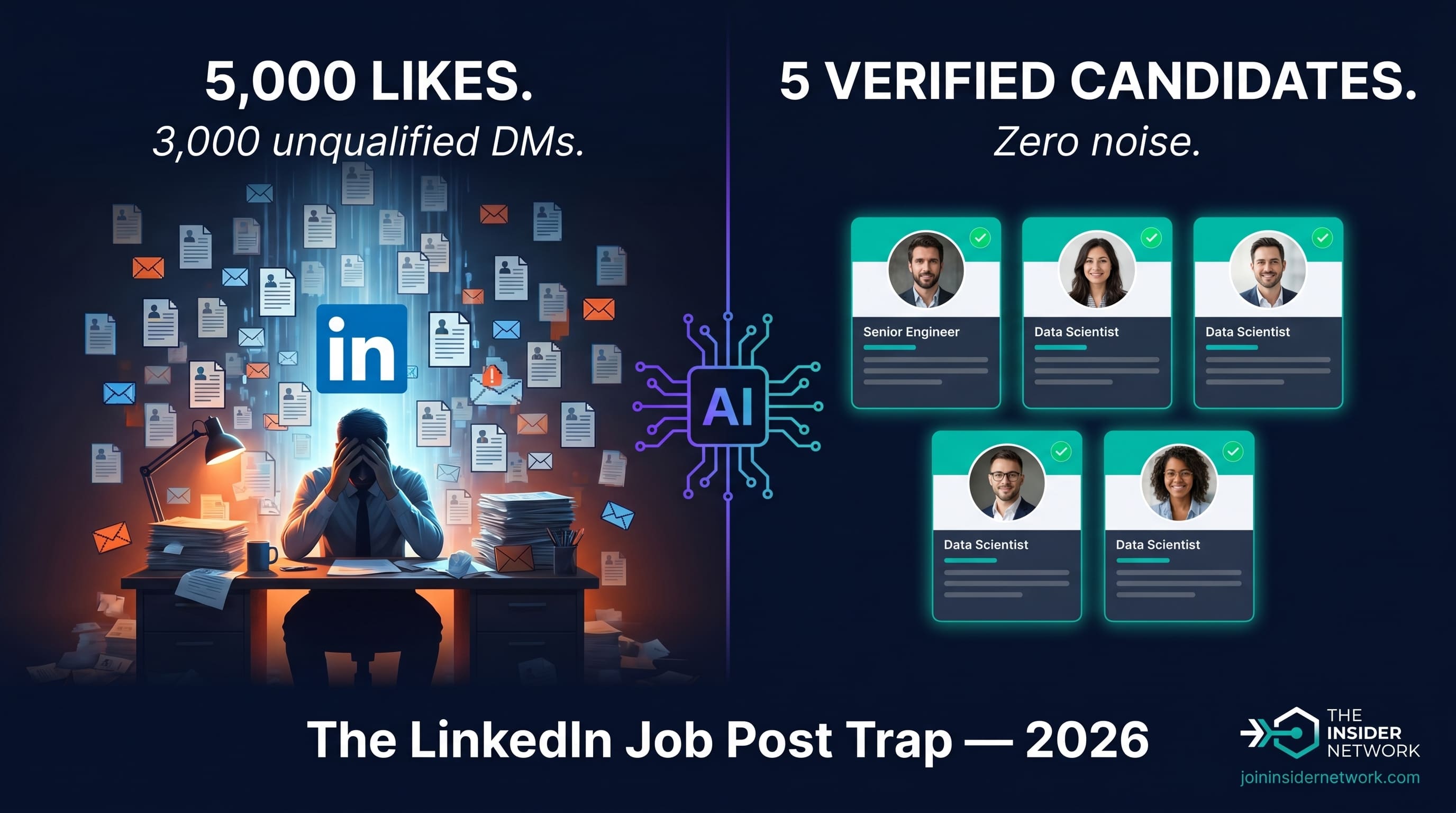
The LinkedIn Job Post Trap: Why 5,000 Likes Is a Recruiter's Nightmare in 2026
You hit post at 9 a.m. on a Tuesday.
By noon, your notifications are on fire.
Shares. Likes. Comments. DMs — hundreds of them.
You went viral. The job post is everywhere.
And by Thursday, you want to quit.
Because going viral on LinkedIn in 2026 doesn't mean you won.
It means you just signed up for 40 hours of unpaid inbox management — and the candidate you actually wanted? They've already moved on.
Here's why the viral dream broke — and what the smartest recruiters are quietly doing instead.
🪤 The LinkedIn Virality Trap
LinkedIn's algorithm is brilliantly simple — and that's exactly the problem.
When your post gets early engagement (likes, comments, shares in the first hour), the algorithm reads that as a signal:
"People care about this. Show it to more people."
So it does.
It pushes your post beyond your network. Beyond your industry. Beyond your target candidate pool entirely.
The algorithm doesn't know the difference between a qualified marketing director and a student who liked the post because the thumbnail looked interesting.
It just knows what got clicked.
So your senior-level LinkedIn job post gets seen by career switchers, recent grads, people in completely different fields, and yes — people who hit "Easy Apply" just to see what happens.
Real scenario: You post a Director of Growth role at 9 a.m. with a clean graphic and an engaging hook. By 2 p.m., it's been shared 400 times. By the next morning, you have 1,847 applications. You wanted 15 sharp candidates with SaaS experience and a proven track record. Instead, you have a second job.
This isn't the algorithm being broken.
This is the algorithm working exactly as designed — for content, not hiring.
💸 What 5,000 Likes Actually Costs You
Let's talk real numbers, because this is money.
| Metric | Number |
|---|---|
| Avg. time to review one application | 7 minutes |
| Unqualified applications from a viral post | 500+ |
| Total time wasted sorting | 58 hours |
| Recruiter avg. hourly rate (~$65K/yr) | ~$31/hr |
| Cost of bad applications alone | $1,798 |
That's a full work week — gone. Just sorting junk.
And that's one role.
That's not a recruiting problem. That's a budget leak.
But here's the part that actually stings.
The candidate you wanted? They applied on Day 1 — before the post exploded. Their resume is buried on page 47 of your inbox. They waited two weeks for a response. They got one from your competitor instead. They started last Monday. You never even opened their profile.
📉 The Noise Problem Is Getting Worse, Not Better
In 2026, AI application tools have made this dramatically worse.
A job seeker can now use AI to tailor a resume, generate a cover letter, and apply to 200 jobs in a single afternoon — without typing a single word manually.
LinkedIn's one-click Easy Apply removes every last bit of friction.
- Zero effort to apply.
- Zero accountability for fit.
- Zero signal in your inbox.
Which means the signal-to-noise ratio is collapsing.
🟢 Signal = the 5 candidates you actually want. 🔴 Noise = the 495 you have to wade through to find them.
This is not a people problem.
Job seekers aren't doing anything wrong — they're playing the game the platform built.
This is a platform design problem. And it is your problem to solve.
Hiring noise in 2026 isn't a trend. It's the new default. Waiting for the platform to fix it is not a strategy.
🧠 What Smart Recruiters Are Doing Instead
The best recruiters in 2026 have quietly stopped playing the volume game.
They've drawn a clear line:
| Approach | What It Looks Like |
|---|---|
| ❌ Public posting | Spray and pray. Post to everyone. Get buried. Spend weeks sorting. |
| ✅ Private, targeted hiring | Precision targeting. Curated shortlist. Delivered to you. |
Think of it this way.
Public posting is like standing in Times Square with a megaphone, yelling your job description at strangers.
Private network hiring is like calling the 5 people you know are perfect for the role — and getting all 5 to call you back.
AI-powered pre-screening is the force multiplier here.
Instead of you filtering 500 people — AI filters 500 people and hands you 5 verified matches.
You don't sort. You decide.
That's not the future of hiring. That's what smart teams are doing right now.
💡 A tip from the smartest recruiters in the room:
Insider Network was built exactly for this.
Post your role privately. Their AI scans every applicant, absorbs the volume, and delivers only the candidates who actually match your requirements.
You get 5 verified profiles — not 500 strangers.
No inbox chaos. No wasted hours. Just the shortlist you actually needed.
Think of it as a colleague saying: "Stop posting publicly. Here's what I switched to. It changed everything."
👤 For Job Seekers: Why Your LinkedIn Application Is Getting Lost
If you're on the other side of this — applying and hearing nothing — this is why.
When a job post goes viral, your application is 1 in 3,000.
The recruiter is drowning. They're not ignoring you. They literally cannot find you.
The smartest move?
Skip the public queue entirely.
- A referred candidate is 4× more likely to get hired than someone from a public post.
- Referrals move through the process significantly faster.
- Your profile reaches a real human — not a filter.
Platforms like Insider Network let you connect with verified employees at companies you want to join — and get referred directly, so your profile reaches a real human, not an algorithm. That's how you get seen in 2026.
✅ How to Post a Job in 2026 Without Losing Your Mind
You don't have to go dark on LinkedIn entirely.
You just have to be smarter about how you post.
Here are five moves that protect your time without killing your reach:
💡 Tip 1: Set an Application Limit
LinkedIn lets you cap applications on a job post.
Set it to 100–150 max for mid-level roles, lower for senior ones.
You get a manageable pool. You close when you're full. Simple.
💡 Tip 2: Use Screening Questions — Even Just 2
Two well-chosen questions eliminate 60% of casual clickers immediately.
Try: "Do you have 5+ years in [specific skill]? Yes / No."
Anyone who answers No and still applies just did you a favor — they self-identified.
💡 Tip 3: Post in Targeted LinkedIn Groups, Not the Open Feed
LinkedIn groups for specific industries have pre-qualified audiences.
Your job post gets seen by people who chose to be in that space — not just anyone the algorithm serves it to.
💡 Tip 4: Use Private Networks for Specialized or Senior Roles
The more senior or specialized the role, the worse a public post performs.
For Director-level and above, private hiring networks are significantly more efficient — both in time-to-fill and candidate quality.
💡 Tip 5: Let AI Do Round One — Always
AI recruitment screening is not a gimmick anymore. It's a necessity.
If you're reviewing 500 applications manually in 2026, that's on the process — not the market.
The tools exist. Use them.
🏁 The Viral Dream Was Never the Goal
Virality was never the metric that mattered.
The right hire was.
The best recruiters in 2026 are not blowing up LinkedIn.
They're quiet, fast, and precise — and their roles get filled in half the time with none of the chaos.
The goal isn't to be seen by everyone. The goal is to be found by the right person.
That requires less noise, not more reach.
Less public, not more viral.
And a lot less time sorted into inbox purgatory.
💬 Has a viral job post ever backfired on you?
Tell me the number of applications you got — and how many were actually worth your time.
Drop it in the comments. The real numbers might surprise everyone.
Article target: /viral-linkedin-job-post-recruiter-nightmare-2026/
Meta Description: Going viral on LinkedIn sounds like a win. In 2026, it's a recruiter's nightmare. Here's the hidden cost — and what smart hiring teams do instead.