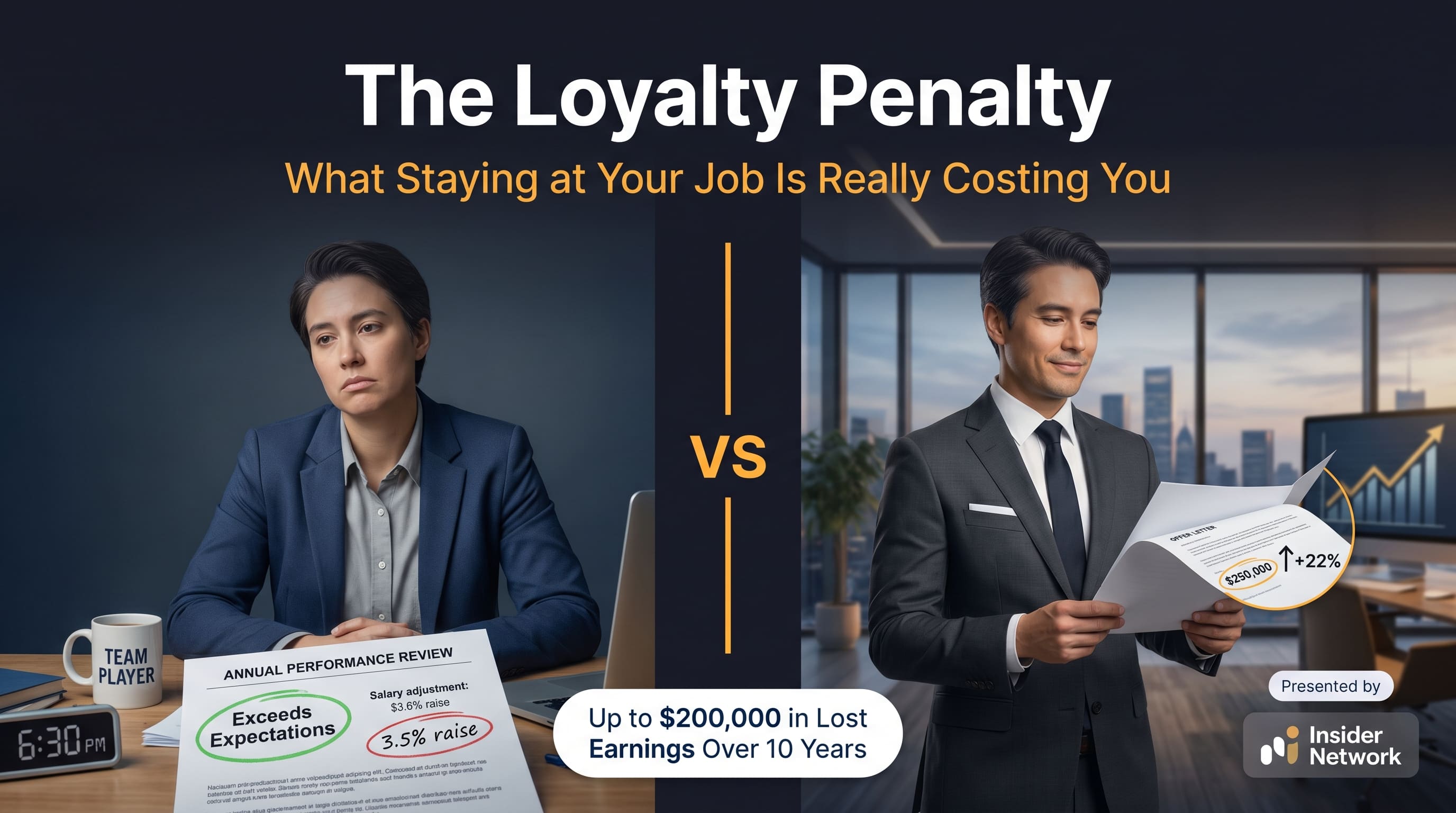
The Loyalty Penalty: How Staying Loyal to Your Employer Is Quietly Draining Your Net Worth
You got a 4% raise last year.
Your performance review said "exceeds expectations."
Your manager called you "invaluable."
Six months later, a new hire joined your team in the exact same role.
You found out — accidentally, the way you always find these things out — that they're making 22% more than you.
Less experience. Same title. More money.
That's not a coincidence.
That's the loyalty penalty salary trap — and it's one of the most expensive financial decisions you will ever make without realizing you're making it.
This article shows you the math, the mechanism, and the exact move to fix it.
How the Corporate Salary Machine Actually Works
Your raise and a new hire's salary are not playing the same game.
They don't even come from the same budget.
Here's how it actually works inside most companies:
- Every year, Finance allocates a raise pool — typically 3–5% of total payroll
- This pool is split across every employee in the company
- Your raise is competing with 50, 100, or 500 other people's raises for the same fixed slice The new hire's salary? That comes from a completely separate external hiring budget — benchmarked directly to current market rates.
Think of it like a pizza.
The raise pool is one slice, cut into 50 pieces and handed around the room. The new hire walks in and gets their own whole pizza. Same kitchen. Completely different order.
This isn't your manager being cruel.
This isn't HR being lazy.
It's structural — baked into how corporate finance works.
And understanding that makes it more important to act on, not less.
The Math They Hope You Never Do
This is the section most companies would prefer you skip.
Let's run two scenarios using a real starting salary of $70,000.
📊 Scenario A — The Loyal Employee
- Year 1: $70,000
- Annual raise: 4% (above the average internal raise — you're being generous here)
- Year 3: ~$78,732
- Year 5: ~$85,163
- Year 10: ~$103,650
After a decade of loyalty and consistent performance — you're earning $103K.
That feels like progress.
Now look at what the other path looks like.
🚀 Scenario B — The Strategic Mover
- Year 1: $70,000
- Changes jobs every 2–3 years with a 15% salary jump each time
- Year 3: $80,500
- Year 6: $92,575
- Year 9: $106,461
- Year 10: earning $118,000+ with a higher base to keep compounding from
The gap after 10 years?
$150,000 to $200,000 in cumulative lost earnings.
Read that again.
That gap isn't just a number on a spreadsheet.
That's a house deposit that didn't happen. A retirement account that's half what it should be. A salary negotiation you already lost without ever sitting down at the table.
And here's the inflation kill shot that makes it even worse.
If inflation is running at 4% and your raise is 3% — you didn't get a raise.
You got a quiet pay cut. Every single year.
The company called it a raise. Your bank account knows the truth.
Why Smart Companies Count On Your Loyalty
Your employer knows exactly what they're doing.
It starts with something called salary anchoring — your starting salary at a company becomes the invisible ceiling for everything that follows.
Salary band — that's the company's internal rule about the minimum and maximum they'll ever pay someone at your level.
Once you're anchored inside that band, the only way to reset it is to leave.
Your manager might genuinely want to pay you more.
But HR systems, compensation bands, and approval chains make it nearly impossible to bridge a 20% market-rate gap internally — even when the intent is there.
And here's the part that stings most.
"Studies consistently show companies spend up to 6x more to replace an employee than to retain them — yet they still won't pay market rate. Why? Because they know most people won't leave."
Your reluctance to switch is a financial asset — to them.
Your comfort, your relationships, your fear of the unknown — these are all things the compensation system quietly counts on.
Your loyalty is real. Their reciprocity is budgeted at 3–5%.
But What About Stability, Benefits, and Vesting?
This is the fair objection. Let's take it seriously.
There are real, legitimate reasons people stay:
- Pension or equity vesting schedules that haven't matured yet
- Health insurance and benefits that would cost more to replace
- Job security during uncertain economic periods
- Relationships, culture, and a team you genuinely respect These aren't excuses. They're real trade-offs.
But before you let them make the decision for you — run the actual math.
A $15,000/year raise from switching jobs covers a lot of lost benefits. A $25,000/year raise covers all of them — and then some.
This isn't about leaving recklessly.
It's about identifying your strategic window — the moment when the math of staying is clearly worse than the math of moving.
That window opens differently for everyone.
But for most people reading this — it's already open.
The Loyalty Penalty by Industry
Not all industries punish loyalty equally — but most punish it significantly.
Here's where the loyalty penalty salary gap is most severe:
-
💻 Technology: Job-hoppers earn 25–40% more over a decade than loyal employees. The market moves fast; internal bands move slowly.
-
💰 Finance & Banking: 15–25% gap. Bonus structures reward tenure — but base salary suppression is real.
-
📣 Marketing & Advertising: 20–30% gap. Skills become "assumed" internally; the market reprices them higher.
-
🛒 Sales: Variable — but base salary stagnation is common even when quota performance is strong. Where the penalty is smaller (but still present):
-
🏛️ Government & Public Sector: Unionized pay scales limit the gap but also limit upside.
-
🎓 Academia: Tenure systems compress the range in both directions.
-
🏥 Healthcare (clinical roles): Credentialing and licensing create natural switching friction — but travel roles and agency work increasingly exploit the gap. The lesson: wherever you sit, the gap exists.
The only question is how wide it's gotten — and how long you're willing to let it grow.
How to Escape the Loyalty Penalty Without Burning Everything Down
You don't have to blow anything up. You just have to move smarter than the system expects.
Here's the 4-step framework.
✅ Step 1: Know Your Market Value Right Now — Today
You cannot negotiate what you don't know.
Check these sources right now:
- Glassdoor — salary ranges by role, company, and location
- Levels.fyi — especially strong for tech roles
- LinkedIn Salary — benchmarks by industry and seniority
- Payscale — good for non-tech roles If your current salary is 15% or more below market rate — the math has already made your decision.
You're not leaving out of emotion.
You're leaving out of arithmetic.
✅ Step 2: Have the Internal Conversation — Once
Before you go anywhere, give your company one clear opportunity.
Go to your manager with market data, not feelings.
Say exactly this:
"I've done some research and found that my market rate for this role is $X. I'd love to stay here — this is my first choice. Is there a path to get my comp to that level?"
If the answer is a clear yes with a timeline — great. Hold them to it.
If the answer is "we'll see," "maybe next cycle," or a weak counter-offer — you have your answer.
This conversation also does something important for you psychologically.
"I tried. I gave them the chance. Now I'm moving with a clean conscience."
✅ Step 3: Move Strategically — Never Desperately
The cardinal rule: never quit before you have an offer.
Target a minimum 15–20% salary jump on any move.
Anything less doesn't justify the switching cost — the time, the stress, the 90-day proving period at a new company.
Move every 2–3 years in your early-to-mid career.
This is the compound growth sweet spot — frequent enough to keep resetting your base, stable enough to not raise red flags on your CV.
❌ Don't jump every 6 months chasing money. ✅ Do move deliberately every 2–3 years chasing market rate.
✅ Step 4: Use Your Network — Not Job Boards
Cold applications have a 2–4% response rate.
That's not a job search strategy. That's a lottery ticket.
Referred candidates are 4x more likely to get hired — and they move through the process 2–3x faster.
Your network is your fastest path to a market-rate salary.
Work it before you open Indeed.
💡 If your network feels thin right now — or you want to get directly referred into a company you're targeting — Insider Network connects job seekers with verified employees at top companies who can refer you from the inside.
Real referrals. Real companies. Real humans — not filters.
It's the fastest way to skip the application pile and land in front of someone who can actually say yes.
You Didn't Get Underpaid Because You Weren't Good Enough
You got underpaid because you trusted a system that was never designed to reward your loyalty — only to benefit from it.
That performance review that called you "invaluable"?
It was true. And the 3.5% raise that followed it was also true.
Both things can be real at the same time.
The company valued you. They just valued their compensation structure more.
Knowing this doesn't make you bitter.
It makes you informed. And informed people make different decisions.
The loyalty penalty salary gap isn't inevitable.
It's a choice — a choice the system makes for you, quietly, every year you don't interrupt it.
Now you know the mechanism.
Now you have the math.
Now you have the four steps.
The only question left is: what are you going to do with it?
How much do you think the Loyalty Penalty has cost you so far? Take 3 minutes, run the rough math using your own salary history, and drop the number in the comments. You might genuinely surprise yourself — and you're not alone.