Top 30 Product-Based Companies in USA (2026): Where Engineers Actually Want to Work
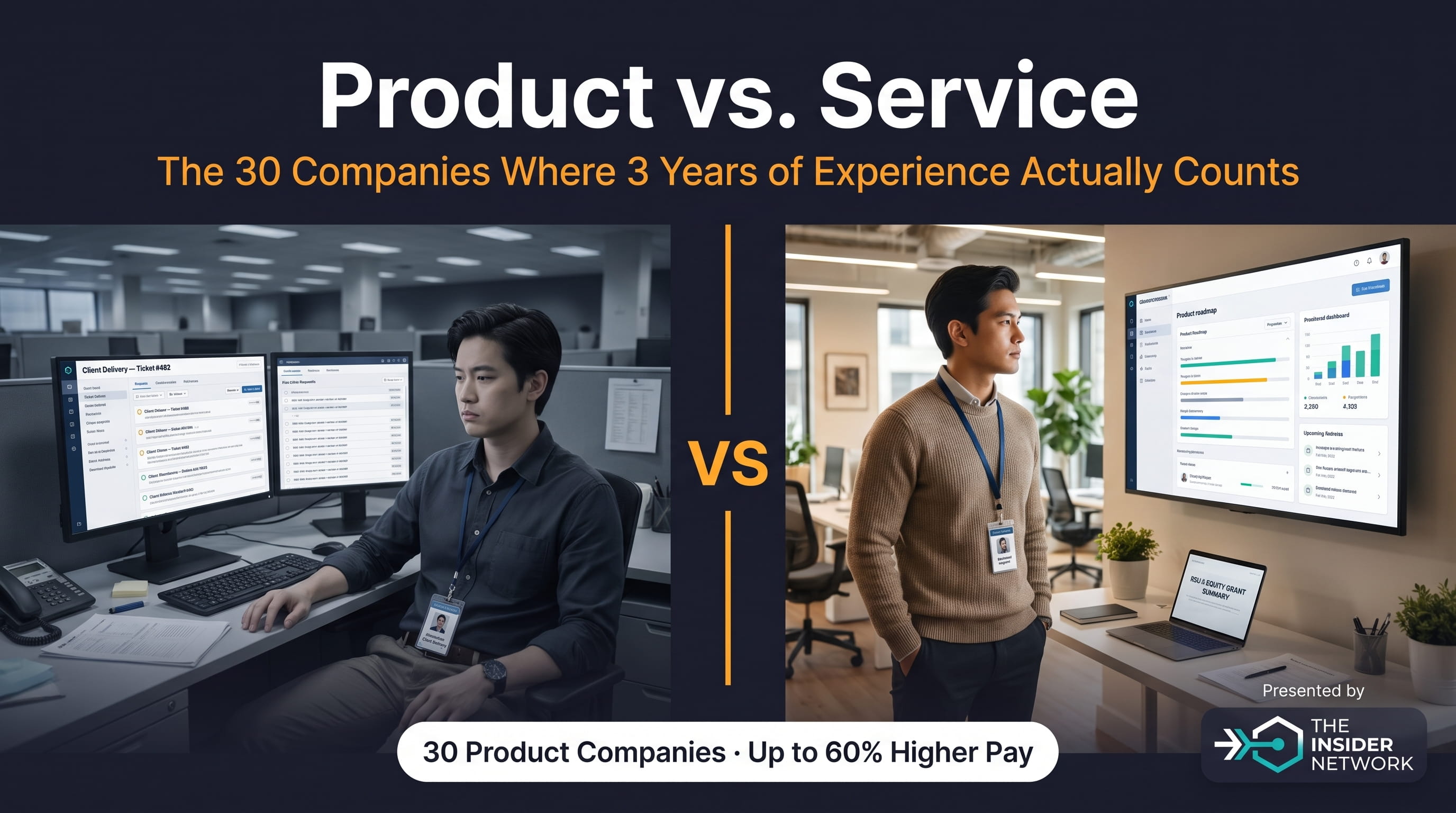
Your resume says 3 years of experience. But if you spent it at a service company, a product company will treat you like a fresher. Here's the list of 30 companies where that 3 years would have actually counted.
That opening stings. It shouldn't.
If you're at a services shop, a consultancy, or an agency right now, you didn't waste your time. You learned to ship under pressure. You learned real stacks. That counts.
But here's the honest gap: at a service company, you built someone else's thing to someone else's spec. At a product company, you own the thing. And ownership is what the next tier of jobs pays for.
This is a clean, honest list of the real product-based companies in USA worth targeting in 2026 — with no outsourcing, staffing, or custom-dev shops sneaking in.
Let's fix the myth first.
Product vs Service Company: What the Numbers Actually Say
Everyone repeats the advice: "Join a product company, not a service company."
Almost nobody explains it with real specifics. So here they are.
Pay tends to be higher. For the same title, total pay at a product company often runs meaningfully above a service or consulting firm — frequently on the order of 30–60% more.
That's a general tendency, not a promise. It varies a lot by role, level, and city.
The reason is structural, not magic. Product companies pay you in base + bonus + equity. Service firms mostly bill your hours to a client, so there's simply less upside to share.
You ship features, not tickets. At a service company, the roadmap belongs to the client. You close tickets.
At a product company, the roadmap is the business. You help decide what gets built — and you live with it in production.
Equity can outgrow salary. This is the part people miss. At a growing product company, stock (RSUs or options) can quietly become the biggest line on your comp — sometimes bigger than base.
At most service firms, there's no equity to speak of. You trade time for money and that's the ceiling.
The skill you build is different. Service work rewards breadth — many clients, many quick builds. Product work rewards depth — one system you know cold, at scale, over years.
Depth is what senior product roles interview for. That's why the jump can feel like starting over.
None of this makes service experience worthless. It makes it a launchpad. Read on.
The 30-Second Litmus Test: Is It Really a Product Company?
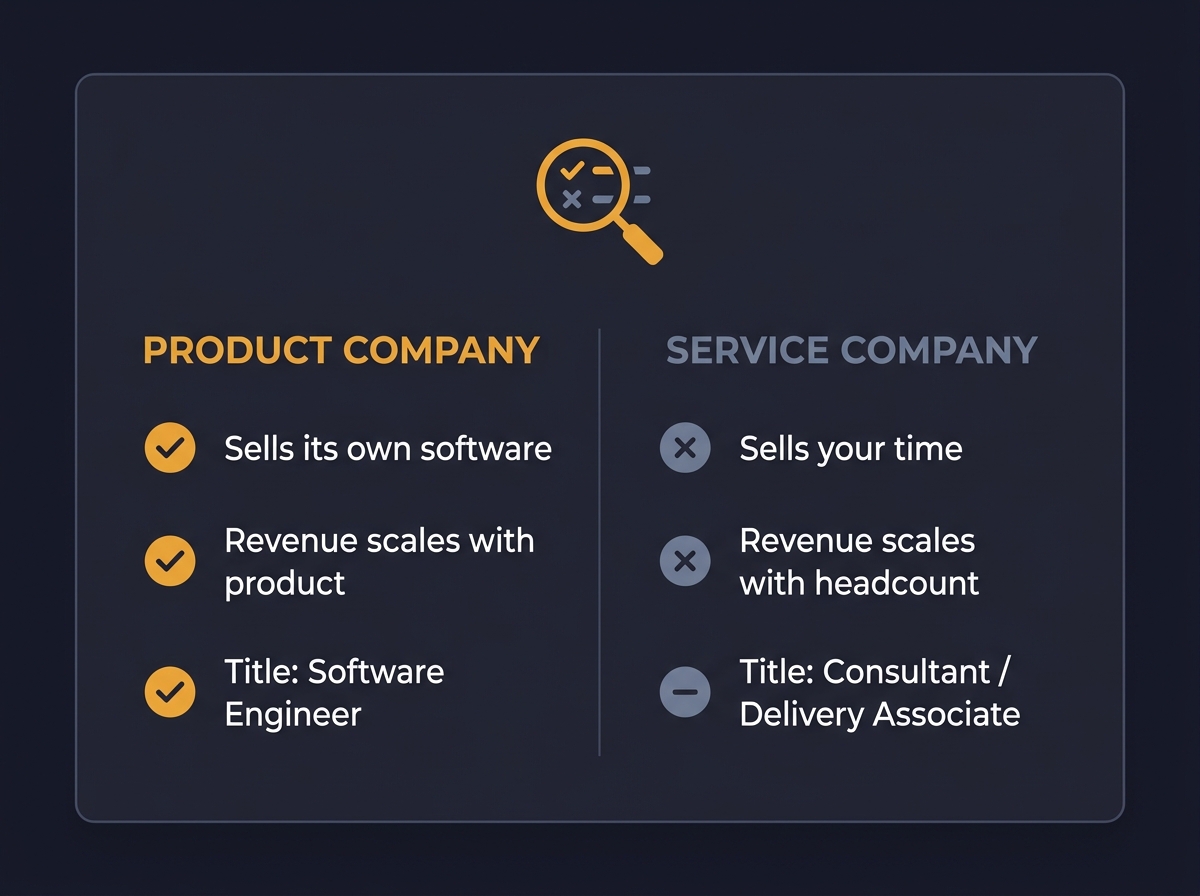
Job listings blur this on purpose. Here's how to check any company yourself, fast.
Ask: What do they sell, and to whom?
- A product company sells its own software, SaaS, or platform to many customers. Think Salesforce selling Salesforce.
- A service company sells your time to build or run software for someone else's business. Think "we deliver custom solutions for clients." Three quick tells that you're looking at a service/staffing firm dressed up as a product company:
- The site talks about "clients," "engagements," and "delivery" more than a product name.
- Revenue scales with headcount — more people = more billable hours. (Product revenue scales with software, not bodies.)
- Job titles read "Consultant" or "Associate — Client Delivery," not "Software Engineer, [Product Name]." If a "top companies" list you're reading quietly includes outsourcing or staffing giants under "product companies," close the tab. It's usually a dev-shop blog ranking itself. This list won't do that.
The 30 Product-Based Companies in USA Worth Targeting in 2026
Every company below owns and sells its own software or platform, and has major US engineering operations. One line each. No filler.
Big Tech & platforms
- Microsoft — owns Windows, Azure, Microsoft 365, and GitHub · deepest surface area in tech, plus a front-row seat to enterprise AI.
- Google (Alphabet) — owns Search, Android, Chrome, and Google Cloud · unmatched scale and systems engineering.
- Apple — owns iOS, macOS, and the App Store · the bar for craft and shipping polish.
- Amazon (AWS) — owns the AWS cloud platform · the place to learn distributed systems at planet scale.
- Meta — owns Facebook, Instagram, and WhatsApp · huge scale and serious open-source (React, PyTorch).
- Nvidia — owns GPUs plus the CUDA software stack · sits at the center of the entire AI economy.
- Netflix — owns the streaming platform · lean teams, high ownership, top-of-market pay.
AI-native companies
- OpenAI — owns ChatGPT and its model API · frontier AI with immediate real-world reach.
- Anthropic — owns Claude and its API · frontier AI with a heavy safety and enterprise focus.
Enterprise SaaS
- Salesforce — owns the Salesforce CRM cloud · the company that defined modern SaaS.
- Adobe — owns Photoshop, Acrobat, and Creative Cloud · creative tooling used by the whole world.
- Oracle — owns its databases and OCI cloud · deep infrastructure and a fast-growing cloud arm.
- ServiceNow — owns the Now workflow platform · one of enterprise software's fastest growers.
- Workday — owns cloud HR and finance software · stable, large-scale enterprise engineering.
- Intuit — owns TurboTax and QuickBooks · consumer-scale fintech with real ML problems.
- Atlassian — owns Jira, Confluence, and Bitbucket · builds the tools engineers use to build.
- HubSpot — owns its CRM and marketing platform · strong product culture in mid-market SaaS.
Data, developer tools & infrastructure
- Snowflake — owns the Snowflake data cloud · center of gravity for modern data work.
- Databricks — owns the lakehouse data-and-AI platform · elite data + ML engineering.
- Datadog — owns its observability platform · a strong bar for backend and reliability work.
- MongoDB — owns the database and Atlas cloud · developer-first, database internals at scale.
- Cloudflare — owns its global edge network platform · systems engineering on the internet's plumbing.
- GitLab — owns the GitLab DevOps platform · all-remote and open-core, if that's your fit.
- Figma — owns the collaborative design platform · design-engineering and hard browser problems.
Fintech & marketplaces
- Stripe — owns payments infrastructure and APIs · a famously high engineering bar.
- Block — owns Square and Cash App · payments and fintech at consumer scale.
- Coinbase — owns its crypto exchange platform · security-critical engineering under real load.
- Airbnb — owns the travel marketplace · product and design engineering people admire.
- Uber — owns its mobility and delivery platform · logistics and real-time systems at massive scale.
- DoorDash — owns its delivery marketplace · dispatch, routing, and marketplace ML problems. That's 30 that clearly qualify. No staffing firms, no outsourcers, no padding to hit a round number.
How to Actually Get In From a Service Background
You don't need to "fix" your resume. You need to translate it.
- Reframe delivery work as product work. Don't list "resolved client tickets." List the system you owned, the scale it ran at, and the outcome you moved. "Cut checkout latency 40% for a payments flow handling 2M requests/day" beats any list of technologies.
- Show one thing you own end-to-end. Product interviewers trust builders. Ship a small real project — a tool, an app, a meaningful open-source contribution. It proves you can go from idea to production without a client handing you a spec.
- Interview like the target, not your current job. Product companies lean hard on data structures, algorithms, and system design. Service interviews often don't. Close that gap deliberately before you apply — it's the single biggest reason strong service engineers get filtered.
- Get a warm referral. This is the real cheat code. Cold applications mostly die in the ATS — the resume screener most big companies use. A referral from someone already inside routes you to a human and jumps the queue. Start with your own network — ex-colleagues who moved to product companies are your best first ask. Company employee-referral programs are the classic path. Platforms like The Insider Network also connect candidates with verified employees who can refer them directly, which helps if you don't already know an insider. (Disclosure: add a line here if you're affiliated with any tool you link.)
A referral won't get an unqualified person hired. It gets a qualified person seen. That's the whole game.
Who This List Is — and Isn't — For
This is for you if: you're at a service company, agency, or consultancy and want the pay, ownership, and equity that product roles offer — and you're willing to prep for a harder interview to get there.
This isn't for you if: you love client variety, short project cycles, and would rather not grind system-design prep. That's a real, valid preference. Service work suits plenty of great engineers.
The point was never that product companies are "better people." It's that they pay for depth and ownership — so if that's what you want, aim there on purpose.
The list of product-based companies in USA above is your shortlist. Pick three. Prep for those three. Get one referral. Start.
FAQ
What is a product-based company? A company that owns and sells its own software, SaaS, or platform to many customers — like Microsoft, Salesforce, or Stripe. It does not build software on contract for other companies' clients. That last part is the whole difference from a service company.
Do product-based companies really pay more than service companies? Usually, yes — often 30–60% more in total pay for the same title, though it varies widely by role, level, and location. The gap comes mostly from equity and higher base bands, since product companies share upside in the software rather than billing your hours to a client.
Can I move from a service company to a product company? Yes, and many people do. The main hurdles are the interview style (heavy on algorithms and system design) and translating "client delivery" experience into "product ownership" language. Prep for those two things specifically.
Are all the companies on this list hiring in the US? All 30 run major US engineering operations. Whether a specific team is hiring changes constantly — check each company's careers page for current openings before you apply.
Is a startup a product company? It depends on what it sells. A startup selling its own app or platform is a product company. A startup that builds custom software for other businesses' clients is a service company, no matter how "tech" it looks. Apply the 30-second litmus test.